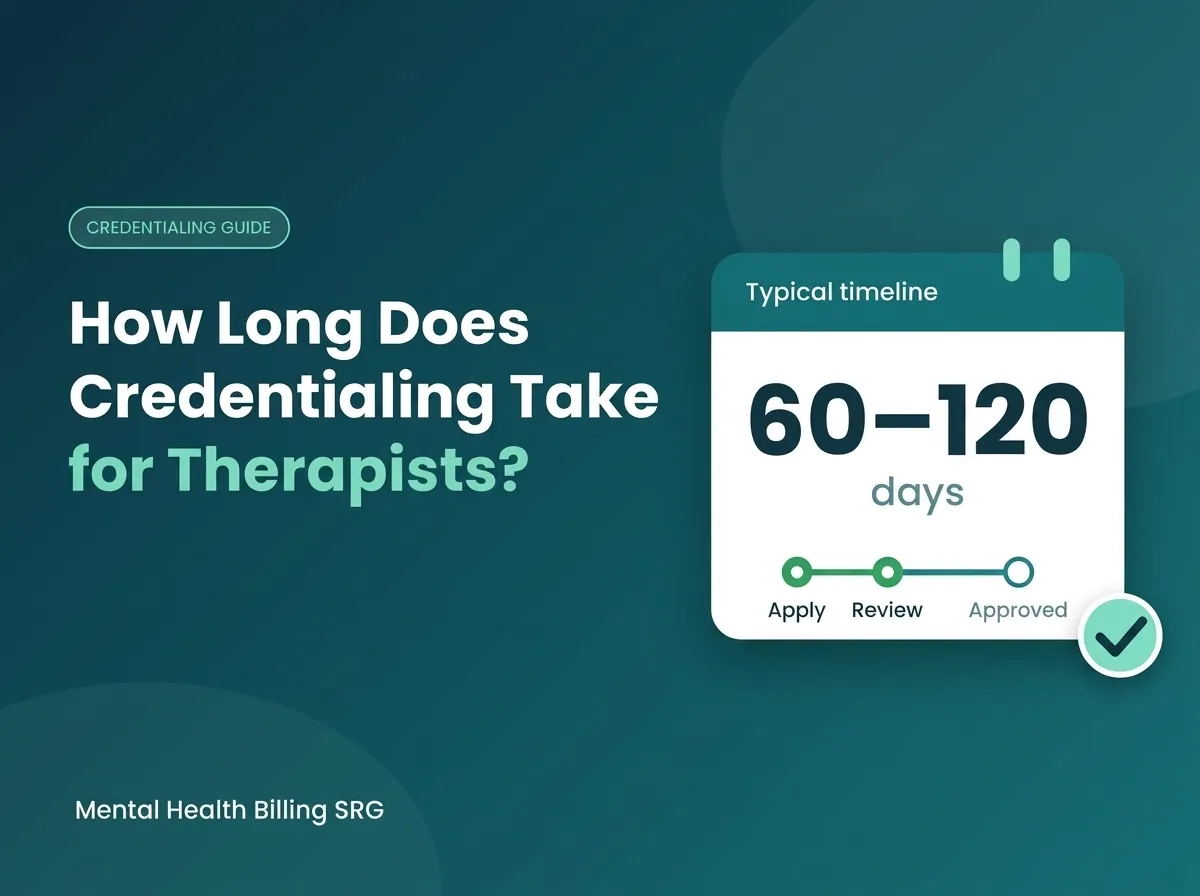
So, how long does credentialing take? For most therapists, psychologists and psychiatrists, insurance credentialing takes about 60 to 120 days. Some payers finish sooner. Others take six months or more. That wait matters. Until an insurance company approves you, you can’t bill it as an in-network provider.
That means fewer patients and slower income while you wait. Mental health providers often wait longer than other providers. Behavioral health networks have their own rules, some panels are closed and payers rarely send updates. In this guide, you’ll learn how long insurance credentialing takes, what slows it down and how to speed it up.
How Long Does Credentialing Take for Therapists?
Most therapists should plan for 60 to 120 days. This count starts when you send a complete application. It covers document checks, payer review and your final contract. Credentialing is not one single step. Every insurance company has its own forms, its own review team and its own schedule.
If you apply to five payers, you may get five different timelines. That is why the therapist credentialing timeline is best seen as a range, not a fixed number. One payer may approve you in 45 days. Another may take 150 days or more. A missing document can push any of them back by weeks.
Credentialing Timeline by Provider Type
Your license type changes the paperwork. It can also change the wait.
Provider type | Typical wait | What payers check | What can slow it down |
LCSW, LPC and LMFT | 60 to 120 days | License, degree and malpractice coverage | Many payers do not accept associate or pre-licensed clinicians, so you may need to wait until you are fully licensed |
60 to 120 days | Doctoral degree, license and work history | Any gap in your history can lead to extra questions and extra weeks | |
60 to 120 days | Board certification, DEA registration and state controlled substance registration | The longest paperwork list, and each extra document can stall an application | |
Varies by clinician | Each clinician’s own documents | Approvals arrive at different times, so plan who can see which patients |
Credentialing Timeline by Insurance Company
The times below are typical ranges. Your wait can be shorter or longer depending on your state, your plan and how complete your application is.
Insurance company | Typical wait | What can slow it down |
Aetna | 60 to 90 days | Missing documents or an out-of-date CAQH profile |
Cigna | 60 to 90 days | A closed network in your area or Cigna needing more information from you. It can run longer. |
UnitedHealthcare | 60 to 90 days | Mental health providers usually go through its behavioral health network, which has its own application steps |
Blue Cross Blue Shield (BCBS) | 60 to 120 days, sometimes more | BCBS is not one company. Each state has its own plan with its own rules. |
What about Medicare and Medicaid? These have their own steps and their own timelines. Medicare enrollment goes through PECOS and Medicaid depends on your state.
Why Credentialing Takes Longer for Mental Health Providers
If you are asking why credentialing is taking so long, these are the most common reasons for mental health providers.
- Separate behavioral health networks. Many insurance plans send mental health providers to a different network than medical providers. That can mean a different application and a different review team.
- Closed panels. Some payers stop taking new therapists in certain areas. You may be told the panel is full and asked to apply again later.
- Different rules by license and state. What works for an LCSW in one state may not work for a psychologist in another.
- Little communication. Payers rarely call or email with updates. Many providers don’t know where their application stands.
Common Reasons for Credentialing Delays
Most credentialing delays come from small mistakes, not big problems. These are the ones we see most.
An expired CAQH attestation
Most payers check your CAQH profile before they approve you. If your attestation has expired, many payers will not move forward and all your open applications can pause at once. Check your profile before you apply and re-attest on time.
Details that don’t match
Your name, address, license number and practice details should be the same on every form and on your CAQH profile. Small differences, like an old address or a missing middle initial, cause big delays. The payer may stop and ask you to fix it and that can add weeks.
Old documents
An expired license or malpractice certificate can stop an application. Payers check these dates before they approve you. Make sure every document is current and note the renewal dates so none expire while your application is open.
Incomplete forms
One blank field or missing signature can send your application to the back of the line. Every payer has its own forms and rules, so a form that works for one may be rejected by another. Check each form before you send it.
No follow-up
Applications can sit untouched for weeks if nobody checks on them. Payers rarely send updates, so silence does not mean progress. Follow up every 7 to 10 days, ask what is missing and write down who you spoke to.
Fixing these before you apply is the easiest way to avoid credentialing delays.
Credentialing Timeline: What to Expect Step by Step
So how long does it take to get credentialed with insurance, week by week? Here is a simple view.
When | What happens |
Week 1 | You gather your documents and set up or update your CAQH profile. |
Weeks 2 to 4 | Applications are checked and sent to each payer. |
Months 2 to 3 | Payers review your application. You or your team follow up on a set schedule. |
Final step | You get approval, a contract and an effective date. |
Some payers move faster and some move slower. Use this as a guide, not a promise.
How to Speed Up Insurance Credentialing
You can’t control how fast a payer works. But you can remove the things that slow you down.
- Start early. Begin 3 to 4 months before you want to see insurance patients.
- Keep your CAQH profile current. Check it before you apply and re-attest on time.
- Gather your documents first. Have your license, degree, malpractice certificate and W-9 ready.
- Apply to all payers at once. Don’t wait for one approval before you start the next.
- Follow up often. Checking in every 7 to 10 days keeps your application from sitting in a pile.
- Keep records. Write down who you spoke to, the date and what they said.
If this sounds like a lot, that’s because it is. Many providers hand this work to a credentialing partner so they can stay focused on patients.
How to Check Your Credentialing Application Status
Payers rarely send updates, so you often have to ask. Here is how.
- Call the payer’s provider relations or credentialing team.
- Have your NPI number and application date ready.
- Ask where your application is and whether anything is missing.
- Write down the name of the person you spoke to and the date.
- Repeat every 7 to 10 days until you get an answer.
If a payer says something is missing, send it right away. Every day you wait adds to your timeline.
How We Can Help
Credentialing is slow, and it takes a lot of paperwork. We take it off your plate. Our mental health credentialing services cover applications, CAQH profile management, payer follow-ups and re-credentialing for providers in all 50 states. We submit applications at the same time and follow up with every payer every 7 to 10 days, so nothing stalls. There are no upfront costs. Ready to get in-network faster? Get your free billing audit and talk to our credentialing team.
Frequently Asked Questions
Can I see patients while I wait for approval?
You can see patients as self-pay clients, but you can’t bill the insurance company as in-network until you are approved. Many payers also do not pay for visits before your effective date, so check each payer’s rules first.
How often do I need to re-credential?
Most insurance companies ask you to re-credential every two to three years. Mark the date in your calendar and start early so you don’t lose your spot in the network.
Can I get credentialed with more than one insurance company at the same time?
Yes. You can apply to several payers at once to save time. Each one reviews your application separately, so approvals arrive on different dates.
How much does credentialing cost?
Doing it yourself costs no fee but takes many hours. Credentialing companies charge a flat fee or a percentage of collections. We charge no upfront costs and no hidden fees, so you only pay when you get paid.
Should I do credentialing myself or outsource it?
You can do it yourself if you’re applying to only a few payers and have the time. Outsourcing makes sense if you’re applying to many payers, running a group practice or want that time for patients.