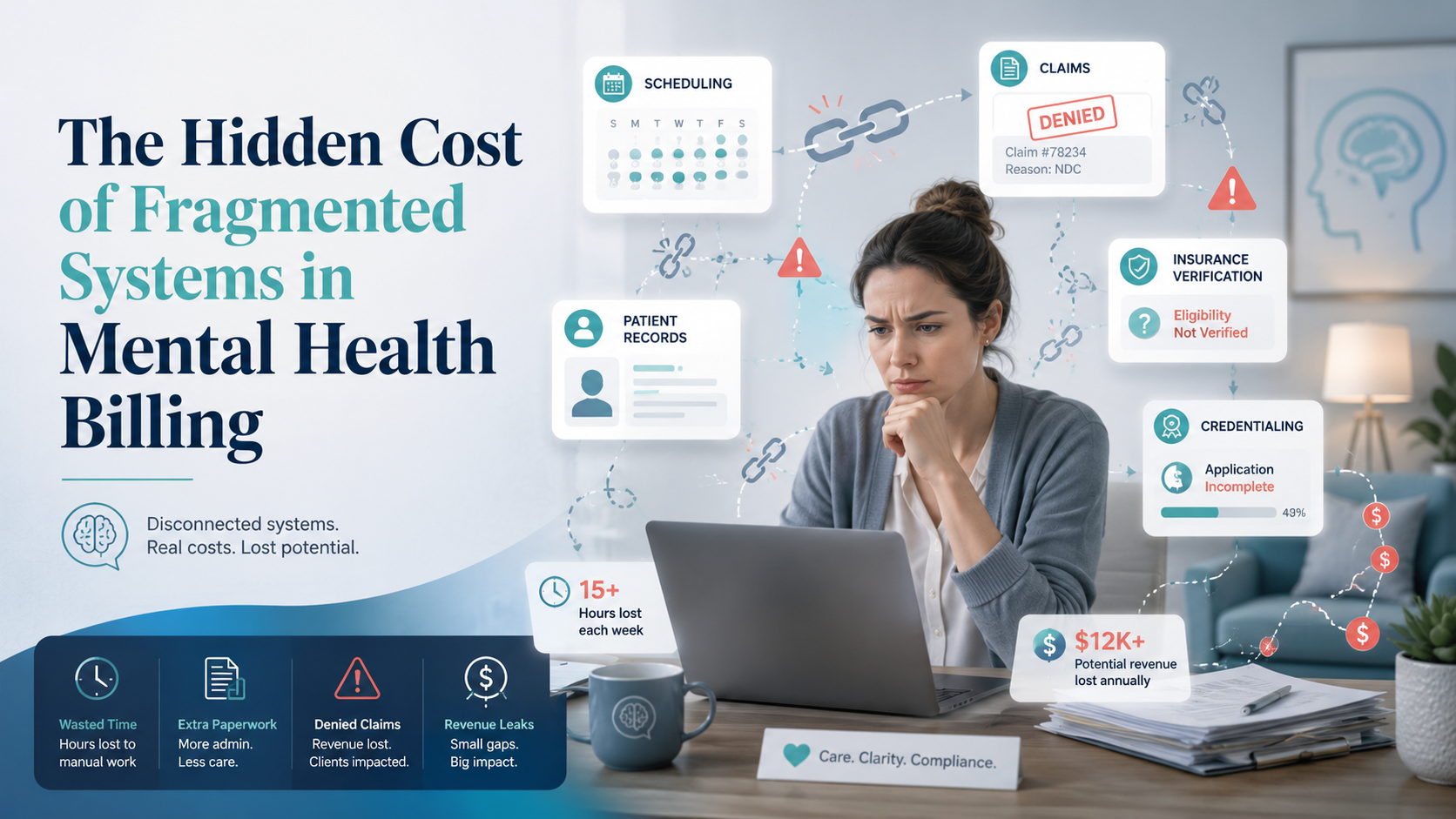
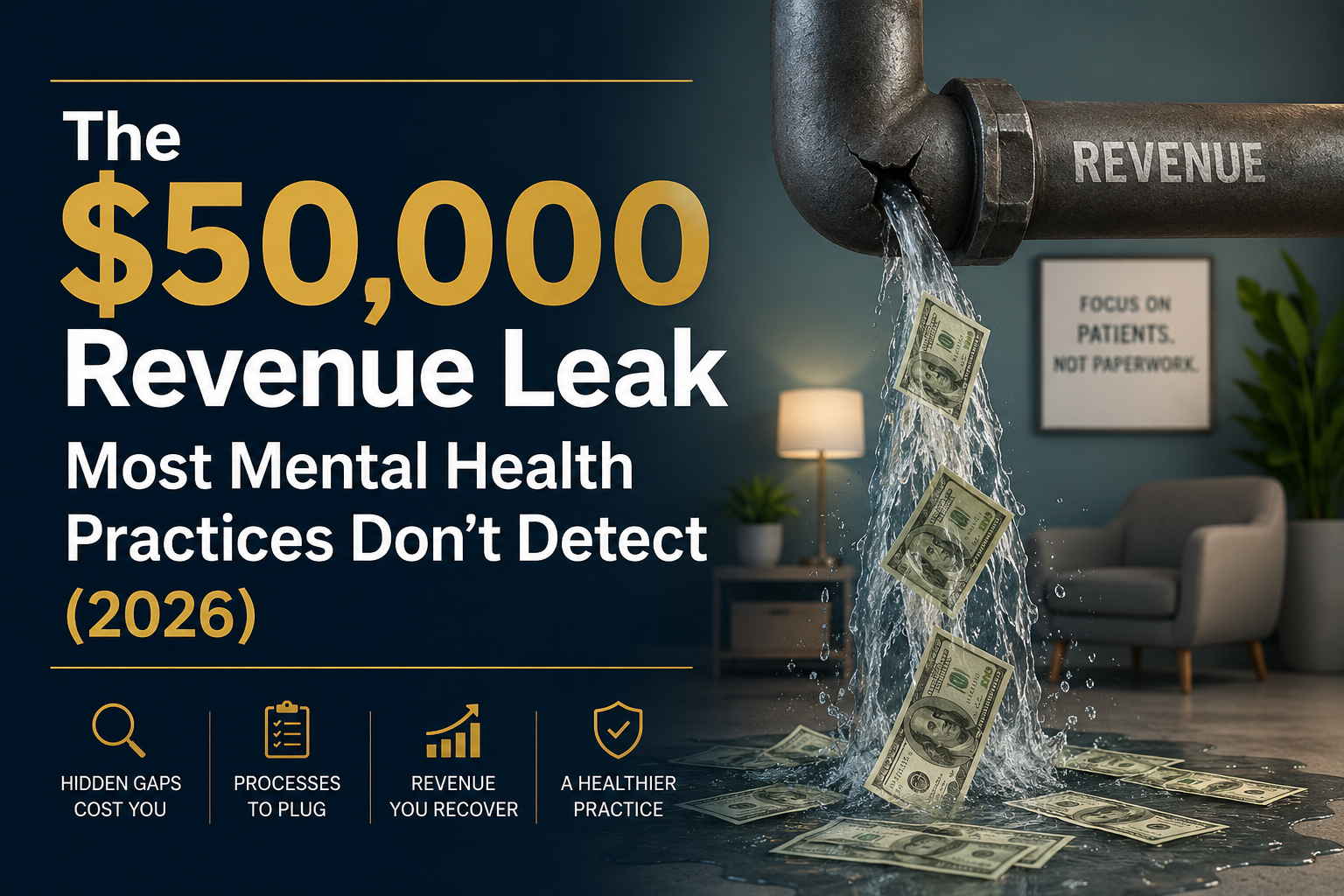
The money is not missing because of fraud. It is missing because of 7 small, quiet, completely fixable billing failures running in parallel.
Most mental health practices never see it coming. The revenue just quietly disappears session by session, claim by claim while the practice keeps running and the provider keeps seeing patients.
Industry data consistently shows that preventable billing breakdowns cost practices 3% to 5% of their total net revenue every single year. For a practice collecting $1 million annually, that is $30,000 to $50,000 walking out the door without anyone noticing.
This guide breaks down exactly where the money goes in a mental health practice and what it takes to get it back.
Why the $50,000 Revenue Leak Most Mental Health Practices Don’t Detect Goes Unnoticed
Most practice owners assume revenue leakage looks like a big obvious denial, a claim that bounces back with a clear rejection code. That is not how it works. The most expensive leaks are invisible. They show up as underbilling, missed add-on codes, write-offs that nobody questions and telehealth claims that get quietly downgraded by the payer without a single notification.
In 2026 the situation is getting worse. CMS has expanded its AI-powered audit capabilities, payers are tightening documentation requirements and the billing environment has shifted into what industry insiders are calling a Hard Market. Every error that slipped through two years ago is now more likely to trigger a denial, a takeback payment, or a compliance flag.
The practices that survive this shift are the ones that find their leaks before the auditors do.
The 7 Revenue Leaks Draining Your Mental Health Practice
Leak #1: The Wrong CPT Code The 90837 vs. 90834 Trap
This is the most common and most costly leak in outpatient mental health billing.
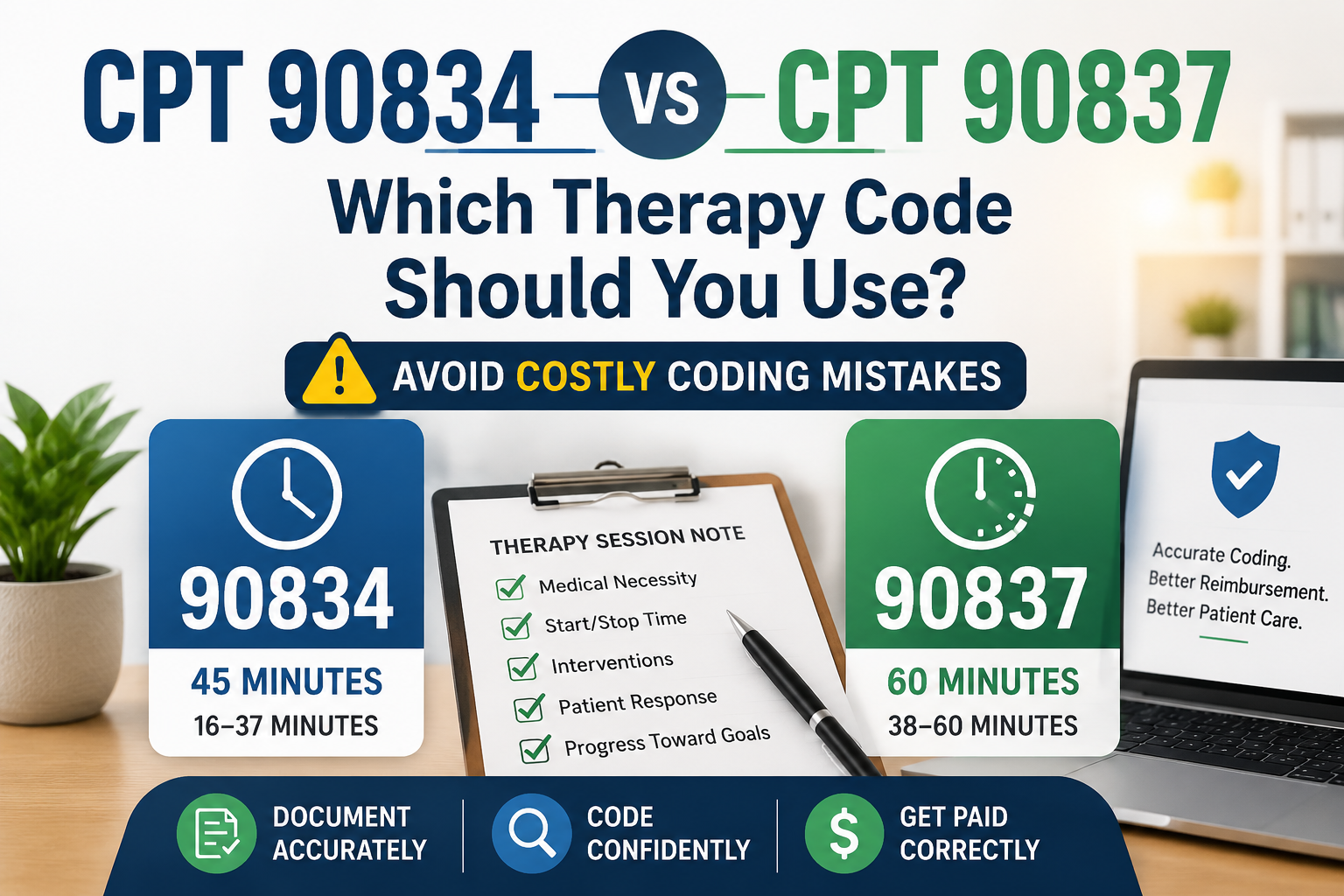
CPT code 90837 is for psychotherapy sessions of 53 minutes or more and reimburses significantly higher than 90834, which covers 45-minute sessions. Many providers bill 90834 out of habit or fear of documenting longer sessions or uncertain whether the time qualifies.
The result is a per-session revenue loss that adds up to thousands of dollars every month for a busy practice. If your providers are consistently seeing patients for 53 to 60 minutes and billing 90834, you are leaving real money uncollected on services already delivered. Auditing your session notes against your submitted codes is the fastest way to find this leak.
Here is the complete guidance for CPD code 90837 and 90834
Leak #2: The Add-On Code Almost No One Bills 90785 Interactive Complexity
CPT code 90785 is an add-on code billed alongside standard psychotherapy codes when a session involves significant communication challenges such as working with a patient who has a legal guardian, a patient with a communication disorder, or complex emotional responses that require additional management during the session.
Most providers never bill this code. Not because their sessions don’t qualify but because nobody told them it existed. When applicable, 90785 adds additional reimbursement to a session the provider was going to deliver anyway. That is pure recovered revenue for work already being done.
The fix is simply to educate your clinical team on when interactive complexity applies and make sure documentation reflects the qualifying factors.
Leak #3: Telehealth Billing Errors
Telehealth billing has never been more important for mental health practices and it has never been easier to get wrong.
The two most common errors are using the wrong Place of Service code and applying the wrong modifier. POS 02 is for telehealth when the patient is not at home, while POS 10 is used when the patient receives services at their home location.
Modifier 95 applies to private insurance telehealth claims and GT applies to Medicaid. Mixing these up results in claim denials or automatic downgrading by the payer often without any notification.
A clear telehealth billing cheat sheet for your front desk and billing team eliminates this leak almost immediately.
Leak #4: Credentialing Gaps
Every mental health practice that hires new clinicians faces this risk and most of them learn about it the hard way.
When a new provider sees patients before their payer enrollment is complete, every claim submitted under their NPI gets denied. Depending on how long the credentialing gap lasts, that can mean weeks or months of sessions that can never be recovered.
The payer will not retroactively reimburse for services delivered before enrollment was active and writing those sessions off is a 100% revenue loss.
The solution is a credentialing calendar with automated alerts that flag upcoming enrollment deadlines weeks in advance. Proactive management of provider credentialing is one of the highest-value investments a growing practice can make.
Leak #5: Denials Written Off Instead of Worked
Denied claims do not always mean lost revenue but most practices treat them that way.
When a claim comes back denied, especially for a small dollar amount, many billing teams write it off and move on. The math feels right at the moment; spending an hour working on a $90 denial does not seem worth it. But when you multiply that across dozens of denials per month, the cumulative loss is significant.
The best mental health patient billing services treat every denial as a recovery opportunity, not a write-off. A clear appeals process with defined timelines, responsible staff and payer-specific appeal templates recovers revenue that most practices assume is gone forever.
Leak #6: Group Therapy Underbilling
Group therapy is one of the most undervalued revenue streams in mental health billing and one of the most commonly billed incorrectly.
CPT code 90853 covers group psychotherapy and is billed per patient per session. Many practices either bill the session as a single unit or use the wrong code entirely, resulting in a fraction of the reimbursement they are entitled to. For a group of eight patients, the difference between billing correctly and billing incorrectly can be hundreds of dollars per session.
Patient billing services for therapists and counselors that specialize in behavioral health know these rules inside out and applying them correctly turns group therapy from an overlooked service into a reliable revenue stream.
Leak #7: A Payer Mix You Have Never Analyzed
Not all insurance plans are created equal and most practices have never sat down to figure out which ones are actually paying them what they are worth.
Low-reimbursing Medicaid managed care plans, capitated contracts and certain commercial payers consistently underpay for mental health services. If your practice is accepting a high volume of patients from these plans without understanding the financial impact, your overall revenue per session may be significantly lower than it should be.
Analyzing your payer mix comparing reimbursement rates, denial rates and average days to payment across each payer gives you the data you need to make smarter decisions about which plans to prioritize and which contracts to renegotiate.
How to Plug These Leaks: A 4-Step Action Plan
Step 1: Audit Your Current Billing Process
Go through each of the seven leaks above and evaluate your practice honestly. Where are your highest denial rates? Which codes are your providers using most often and do the session notes support them? When did you last review your payer mix?
Step 2: Track the Right Data
You cannot fix what you are not measuring. Monitor your denial rate by payer and by reason code every month. Track your clean claim rate, your average days in AR and your net collection rate. These numbers tell you exactly where your revenue cycle is breaking down.
Step 3: Train Your Clinical and Billing Team
Fear-based coding, billing lower codes to avoid scrutiny is one of the most expensive habits in mental health practices. Empower your providers with accurate documentation training and give your billing team the CPT code knowledge they need to submit claims with confidence.
Step 4: Automate Where Possible
Automated eligibility verification catches coverage issues before the patient walks in the door. Prior authorization tracking tools prevent authorization lapses from turning into denied claims. The right technology stack reduces the manual workload and removes the human error points where leaks most often occur.
The Revenue Is Recoverable But Only If You Act
The $50,000 revenue leak is not a myth. It is a daily reality for many mental health practices running on tight margins while delivering essential care to the patients who need it most. And it is entirely fixable not with a massive overhaul, but with targeted corrections to the specific breakdowns that are quietly draining your revenue right now.
Every one of the seven leaks described above has a clear, actionable solution by active mental health billing services. The practices that find and fix them do not just recover lost revenue, they build a billing operation that protects their income going forward, even as payer rules tighten and audit activity increases in 2026.
Schedule a free revenue leak audit with our mental health billing experts today. We will go through your billing data, identify exactly where your practice is losing money, and give you a clear plan to get it back. So you can keep more of what you earn and focus on the work that matters most.
FAQ
What is the most common billing error causing revenue leakage in mental health practices?
The most common error is incorrect CPT code selection billing 90834 (45 min) instead of 90837 (60 min) . This “conservative billing” out of fear of audits costs $15–$30 per session, adding up to $28,000+ annually per provider.
How can I detect “silent” revenue leaks in my practice?
Look for patterns: frequent small adjustments from the same payer, the same procedure repeatedly needing manual review, or a payer consistently underpaying a specific CPT code . Run a CPT bell curve analysis to compare your coding to national benchmarks and audit remits for underpayments, not just denials.
What is “under-coding,” and how much revenue does it cost my practice?
Under-coding is billing a lower level of service than documentation supports (e.g., 99213 instead of 99214) out of fear of audits . The difference is $30–$40 per visit. If you downcode just 5 patients a day, that’s $50,000 a year per provider lost to fear.
Can a poor EHR setup really cause revenue leakage?
Yes. Default CPT selections, missing payer rules, and lack of real-time eligibility checks are responsible for many administrative denials . A quick audit of your system’s billing settings can reveal and fix these “invisible” leaks.
How can I recover money from a denied claim that was never appealed?
First, implement a structured denial management workflow log denials by payer and reason, assign them for follow-up and track deadlines . Most payers allow 60–180 days for appeals, so immediate action is critical.