A few minutes can make a big difference. Whether your session runs 45 minutes or 60 minutes decides which code you bill, how much you get reimbursed and whether your claim sails through or gets flagged for an audit.
CPT codes 90834 and 90837 look similar on paper, but mixing them up is one of the most common and costly mistakes in mental health billing. This guide breaks down exactly when to use each one, what your documentation needs to say and how to avoid the coding mistakes that put your claims and your practice at risk.
What CPT 90834 and 90837 Actually Mean
These two codes both cover individual psychotherapy sessions; the only real difference is how long the session runs.
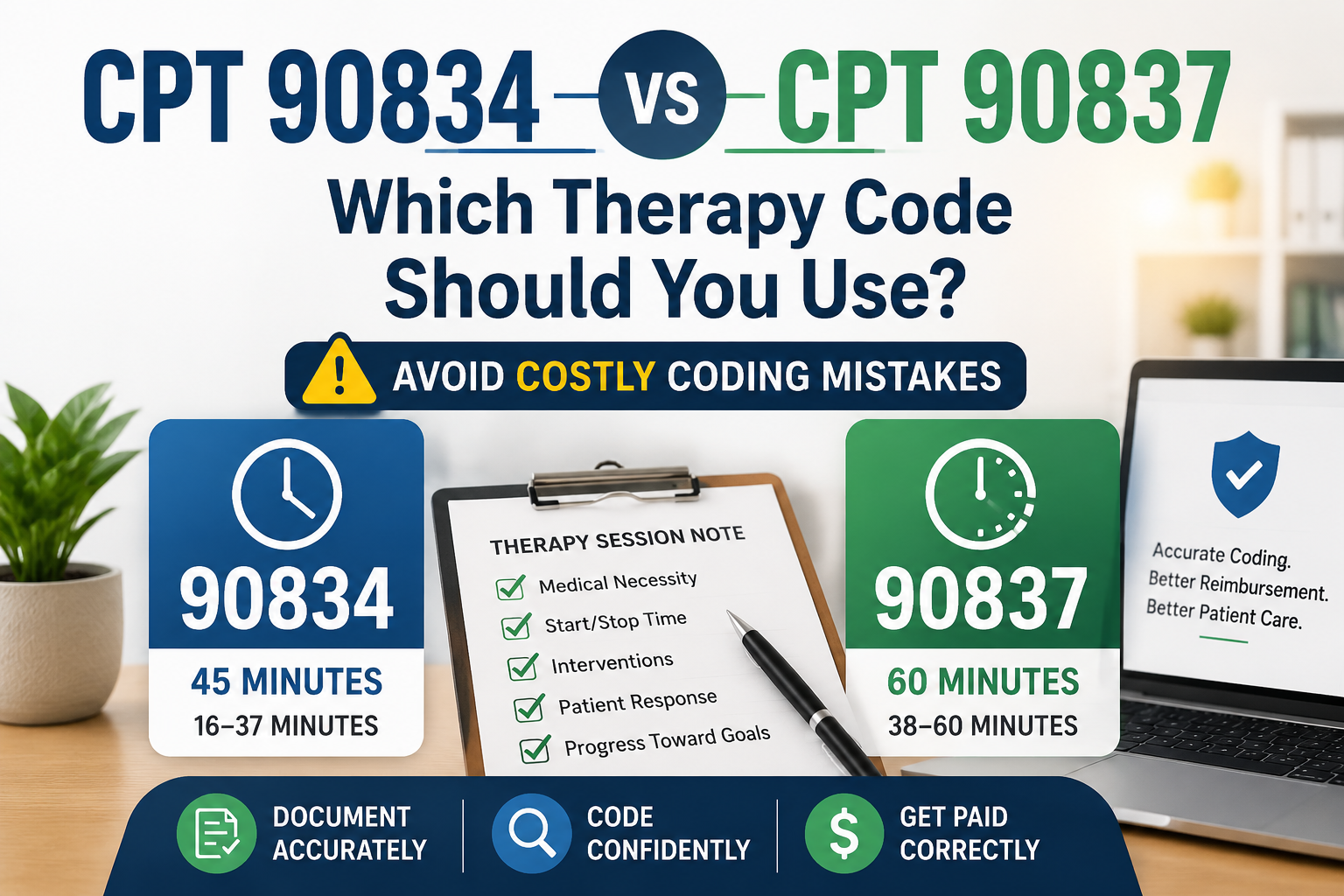
90834 covers sessions between 38 and 52 minutes. This is your standard therapy session, used for stable patients working through ongoing treatment goals.
90837 covers sessions of 53 minutes or more. This is for extended sessions, usually when deeper clinical work is needed like trauma processing or a patient in crisis.
| CPT Code | Session Length | Typical Use | Reimbursement |
| 90834 | 38–52 minutes | Standard outpatient therapy | Standard |
| 90837 | 53+ minutes | Extended or complex sessions | Higher |
The code has to match the actual time spent with the patient, not just what was scheduled.
Where This Confusion Actually Comes From
Here’s something most guides don’t tell you: the mix-up between 90834 and 90837 usually isn’t a training problem, it’s a systems problem.
Most EHRs and scheduling tools default every appointment slot to 60 minutes. So even if a session actually runs 45 minutes, the system is already set up to nudge the billing code toward 90837 because that’s what the calendar block says, not what actually happened in the room.
Over time, this quietly creates a pattern: a practice ends up billing far more 90837 than its real session lengths would support. Nobody’s trying to overbill, it’s just the default setting doing its job. But to a payer looking at the numbers, that pattern looks exactly like overcoding, whether it was intentional or not.
When to Use 90834
Use 90834 for your standard, everyday therapy sessions with a stable patient working through ongoing treatment goals, nothing out of the ordinary clinically.
Your documentation should include:
- Session start and end time
- What the patient reported (mood, symptoms, how things have been since the last visit)
- Your clinical observations
- Progress toward treatment goals
- The plan going forward, including any homework or next steps
This is the baseline code for most outpatient sessions; it’s not a lesser code, it’s simply the right one for routine care.
When to Use 90837
Use 90837 only when the session genuinely ran 53 minutes or longer and the extra time was clinically necessary, not just how the conversation happened to go. Think trauma processing, a patient in active crisis, or a complex case that needed deeper work.
Your documentation must include:
- Exact session start and end time
- Clear medical necessity why the extended time was needed, not just that it happened
- The specific clinical complexity involved
- The intervention used and how the patient responded
Weak documentation (won’t hold up if reviewed): “Patient required extended support.”
Strong documentation (clearly justified): “Patient presented in acute distress following a trauma disclosure. The session extended to 65 minutes to complete trauma processing and stabilization.”
If your notes don’t clearly support the extra time, the code won’t hold up no matter how the session actually went.
The 52-vs-53-Minute Problem: Where Most Practices Get Tripped Up
One minute can change everything. A session that runs 52 minutes bills as 90834. The exact same session running 53 minutes bills as 90837. Same patient, same clinical work, different code and different reimbursement.
This is where a lot of practices get tripped up, especially when a clinician rounds up out of habit (“it was basically an hour”) instead of writing down the real time.
Weak documentation: “The session lasted about an hour.”
Strong documentation: “Session start: 2:00 PM. Session end: 2:53 PM. Total time: 53 minutes.”
The rule is simple: don’t round, don’t estimate write the exact start and end time, every single session. That one habit makes your code choice defensible no matter which side of the line it falls on.
Crisis and Interactive Complexity Codes You Should Know
Not every session fits neatly into 90834 or 90837. A few other codes cover situations that come up more often than you’d think:
90839 Used for crisis psychotherapy, the first 60 minutes of urgent, high-intensity intervention with a patient in crisis.
90840 An add-on code for crisis sessions that run longer than 90839 covers, billed in 30-minute increments after the first hour.
90785 An add-on code for interactive complexity, used when a session involves extra communication challenges, like working with a young child, using an interpreter, or managing a highly distressed or disruptive patient.
These aren’t replacements for 90834 or 90837 they’re used alongside or instead of them and they have a most important role in mental health billing solutions depending on the situation. Knowing when they apply means you’re not stuck choosing between two codes that don’t actually fit what happened in the session.
The Related Codes Most Guides Skip
90834 and 90837 aren’t the only codes you’ll run into. Here’s a quick look at a few others worth knowing:
90832 For brief sessions, 16 to 37 minutes. Common for short check-ins or shorter therapy formats.
90833 / 90836 / 90838 Add-on codes used when a psychiatrist provides psychotherapy alongside a medication management visit (E/M code). These aren’t billed alone; they’re added on top of the E/M code for that session.
90846 / 90847 For family therapy, depending on whether the patient is present (90847) or not (90846). These are separate from individual therapy codes entirely.
Knowing these helps you avoid billing the wrong category of session altogether not just the wrong time length.
Why Overusing 90837 Puts Your Practice at Audit Risk
Insurance payers track patterns, not just individual claims. They know what a typical outpatient mental health practice looks like, usually a mix of 90834 and 90837, not one code dominating almost every session.
If your practice bills 90837 for the vast majority of sessions, it stands out statistically, that’s not what a normal caseload looks like. And when a payer notices that pattern, it can trigger a pre-payment review, meaning your claims get held up and scrutinized before you’re paid at all.
If they find sessions that were coded 90837 without documentation to back it up, you could face recoupment meaning the payer takes back money they already paid you, sometimes for months of claims at once.
The fix isn’t complicated: bill what the session actually was, and make sure your notes prove it.
Do All Payers Follow the Same Rules? (Medicaid vs. Commercial vs. Medicare)
Short answer: mostly the same time rule, but not always the same requirements around it.
Medicare, Medicaid and commercial insurers all generally follow the same 38–52 minute rule for 90834 and the 53+ minute rule for 90837. Where they differ is in the details around it. Reimbursement rates vary a lot too. Medicaid typically pays less per session than commercial insurance and the exact rate depends on the state program.
Telehealth is a good example of where the differences show up. Most commercial payers and Medicare use modifier 95 for video telehealth sessions. But a few state Medicaid programs still require the older modifier GT instead, using the wrong one can get your claim rejected even if the code and session time were correct.
The takeaway: don’t assume every payer works exactly the same way. Always check the specific rules for each payer, especially with Medicaid, before you submit.
What Happens If You’ve Already Billed the Wrong Code
Mistakes happen, the real question is what you do next.
If you catch a coding error after the claim’s already been submitted, you’ll need to file a corrected claim. This means resubmitting the claim with the right code and a note that it’s a correction, not a brand-new claim. Most players require this to be done a specific way, so it processes correctly instead of getting rejected as a duplicate.
The tricky part is you have to catch it first and by the time a payer flags it or a random audit turns it up, you could be looking at months of claims that need fixing, not just one.
This is exactly the kind of mistake that gets caught before it happens with the right claim submission process checking documentation against the code before the claim ever goes out, instead of finding the problem after the fact.
How to Get This Right Every Time
A few simple habits go a long way:
Track actual session time not the scheduled slot, the real start and end time.
Document medical necessity especially for 90837, always explains why the extra time was needed.
Review your code distribution regularly check monthly if your 90834-to-90837 ratio looks realistic, not just what feels routine.
Even with the best habits, manual tracking still leaves room for error: a busy day, a rushed note, a default calendar slot. That’s exactly where claim submission services for mental health providers step in, checking every claim against the documentation before it ever goes out, so mistakes get caught before they cost you.
Get the Coding Right Then Get the Submission Right Too
Knowing when to use 90834 vs 90837 is a big step toward cleaner claims. But correct coding is only half the job if the claim isn’t submitted accurately and on time, even a perfectly coded session can still get delayed or denied.
That’s exactly what our Claim Submission Services for Mental Health Providers are built for checking every claim before it goes out, so your coding actually turns into revenue.
FAQs
What happens if my session runs exactly 53 minutes?
53 minutes hits the minimum for 90837, so that’s the code to bill just make sure your documentation clearly shows the start and end time.
Can I bill 90837 for telehealth?
Yes, 90837 is billable for telehealth sessions, but you’ll need the correct modifier attached, like modifier 95.
What if I’ve been overusing 90837 without realizing it?
Review your recent claims and compare session times to what was actually billed. If you find a pattern, correct future claims going forward and consider fixing past ones through a corrected claim before it gets flagged.
Do all insurance payers use the same time thresholds?
Most follow the same 53-minute cutoff, but not all always double-check with your top payers instead of assuming.
How can a claim submission service help prevent these errors?
A claim submission service checks your documentation against the code before the claim goes out, catching mismatches early instead of after a payer flags them.