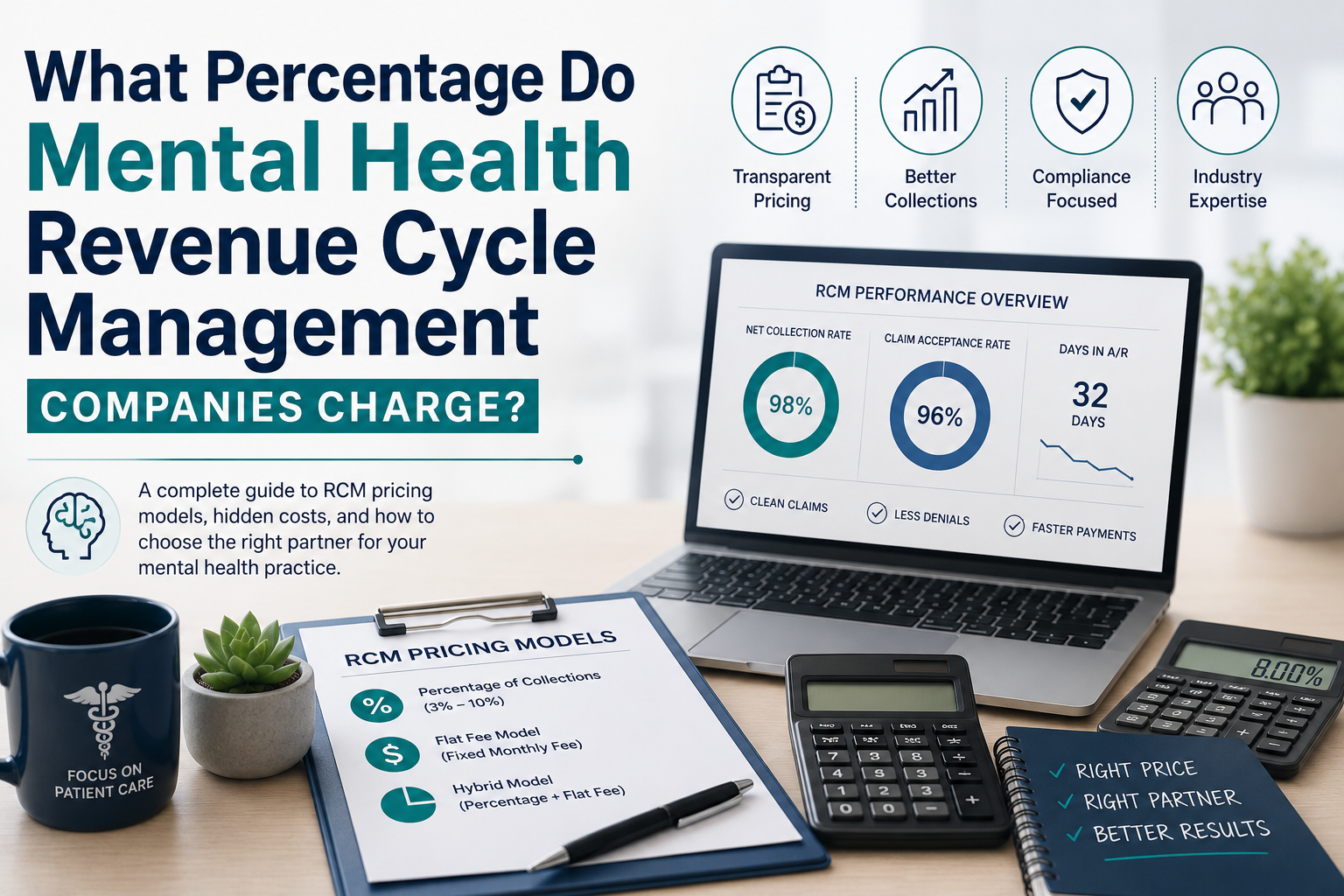
Mental health revenue cycle management (RCM) companies typically charge between 3% and 10% of successfully collected revenue. Most solo therapists and small behavioral health practices pay 6% to 8%, while larger, high-volume organizations often negotiate rates below 5%. Practices with more complex billing requirements such as substance use disorder (SUD) or applied behavior analysis (ABA) providers may pay closer to 10% due to increased administrative complexity.
The percentage alone does not tell the full story. Pricing varies based on factors such as practice size, payer mix, claim volume, denial rates, and the services included in the RCM agreement. Understanding how these variables affect costs is essential when comparing vendors and determining whether outsourcing revenue cycle management will improve your practice’s financial performance.
How Mental Health RCM Pricing Works
Most mental health revenue cycle management (RCM) companies charge a percentage of the revenue they successfully collect, rather than a fixed fee for every claim submitted. This performance-based pricing model aligns the RCM company’s success with your practice’s financial performance; if claims aren’t paid, the RCM company doesn’t earn its full fee. While percentage-based pricing is the industry standard, some providers also offer flat-fee, per-claim, or hybrid pricing models depending on the practice’s size and billing needs.
The percentage covers far more than claim submission. An RCM partner manages the entire revenue cycle from verifying insurance eligibility before a patient visit to resolving denied claims and posting payments after reimbursement. The broader the scope of services included, the higher the percentage may be.
The Three Stages of Mental Health Revenue Cycle Management
Understanding what happens throughout the revenue cycle helps explain why pricing varies between providers.
| Revenue Cycle Stage | What Happens | Why It Matters |
| Front-End | Insurance eligibility verification, benefits checks, prior authorizations, patient registration | Prevents avoidable claim denials before services are delivered. |
| Mid-Cycle | Medical coding, charge capture, claim scrubbing, and electronic claim submission | Improves first-pass claim acceptance and reduces coding errors. |
| Back-End | Payment posting, denial management, appeals, accounts receivable (A/R) follow-up, and patient billing | Maximizes collections, shortens reimbursement timelines, and recovers unpaid revenue. |
Percentage of Collections: The Most Common Pricing Model
The majority of behavioral health RCM companies charge 3% to 10% of successfully collected revenue, with 5% to 8% being the most common range. Instead of billing for every claim submitted, they calculate their fee based on the insurance payments and patient balances your practice actually collects.
Example: If your practice receives $80,000 in reimbursements during a month and your RCM partner charges 6%, your monthly RCM fee would be $4,800.
Because compensation is tied to collections rather than submissions, RCM providers have a strong incentive to reduce denials, follow up on unpaid claims, and improve your overall collection rate, not simply process more claims.
Typical Mental Health RCM Pricing by Practice Size
While every RCM provider has its own pricing model, percentage-based fees generally decrease as claim volume and monthly collections increase. Larger practices often negotiate lower rates due to operational efficiencies.
| Practice Type | Typical RCM Fee | Typical Service Level |
| Solo Provider | 6%–9% | Standard billing, claim submission, and follow-up |
| Small Group (2–5 Providers) | 5%–8% | Full RCM with moderate claim volume |
| Large Group Practice | 4%–7% | Lower negotiated rates based on higher collections |
| Complex Behavioral Health Practices (ABA, SUD, IOP, PHP) | 7%–10% | Higher-touch RCM with intensive authorization and denial management |
Note: These are general industry benchmarks. Pricing can depend on your practice’s payer mix, denial rates, billing complexity, technology stack, and the services included in the RCM agreement.
What Determines the Percentage an RCM Company Charges?
Mental health revenue cycle management Services don’t use a fixed pricing formula. While most providers charge between 3% and 10% of monthly collections, the final percentage depends on the complexity of your revenue cycle, not just your monthly revenue. Practices that require more time, specialized expertise, or ongoing claim management typically pay higher rates because they demand more resources to achieve consistent reimbursements.
Scope of RCM Services
The services included in your agreement have the greatest impact on pricing. A lower percentage may cover only claim submission and payment posting. At the same time, a higher fee often includes insurance eligibility verification, prior authorizations, medical coding, denial management, accounts receivable (A/R) follow-up, patient billing, credentialing, compliance monitoring, and financial reporting. When comparing vendors, always compare the scope of services, not just the percentage.
Practice Size and Monthly Collections
Higher-volume practices can often negotiate lower percentage rates because they generate a consistent flow of claims and reimbursements. This allows RCM companies to spread their operational costs across a larger revenue base. Solo therapists and smaller behavioral health practices typically pay slightly higher percentages since the administrative workload remains relatively fixed regardless of collection volume.
Specialty and Billing Complexity
Not all behavioral health services are equally complex to bill. Practices offering substance use disorder (SUD) treatment, applied behavior analysis (ABA), intensive outpatient programs (IOP), or partial hospitalization programs (PHP) often require frequent authorizations, specialized coding, and extensive payer documentation. As billing complexity increases, the percentage charged by an RCM provider may also increase.
Payer Mix and Claim Denial Rates
Working with multiple commercial insurers, Medicare, or Medicaid introduces different billing rules, documentation requirements, and reimbursement policies. If a practice also has a history of frequent claim denials, the RCM provider must invest additional time in claim corrections, appeals, and payer follow-up. Since these activities require more labor, they often result in higher pricing.
EHR Integration and Workflow Efficiency
Your existing electronic health record (EHR) and practice management software can also influence pricing. RCM companies generally work more efficiently with modern, fully integrated systems that automate charge capture, coding, and claim submission. Practices using older, customized, or disconnected systems may require additional manual work, staff training, or data reconciliation, which can increase the overall cost of revenue cycle management.
What’s Included in a Mental Health Revenue Cycle Management Service?
RCM service manages the entire financial lifecycle of your practice from verifying a patient’s insurance before treatment to collecting the final reimbursement after a claim is paid. Unlike general medical billing, behavioral health RCM also addresses specialty-specific requirements such as therapy documentation, prior authorizations, payer-specific billing rules, and behavioral health coding. The goal is to reduce administrative workload, minimize claim denials, and maintain a predictable cash flow.
| Service | What It Does | Why It Matters |
| Insurance Eligibility Verification (VOB) | Confirms a patient’s active insurance coverage, behavioral health benefits, deductibles, and copays before treatment begins. | Prevents avoidable claim denials caused by inactive coverage or benefit limitations. |
| Prior Authorization Management | Obtains insurer approval for services that require authorization before care is delivered. | Reduces reimbursement delays for services such as IOP, PHP, ABA, and SUD treatment. |
| Medical Coding & Charge Capture | Converts clinical documentation into accurate ICD-10, CPT, and HCPCS codes before claims are submitted. | Accurate coding improves first-pass claim acceptance and helps maximize eligible reimbursement. |
| Claim Submission & Tracking | Submits electronic claims to clearinghouses and insurance payers while monitoring claim status throughout the process. | Detects processing issues early and prevents unnecessary payment delays. |
| Denial Management & Appeals | Identifies denied or rejected claims, resolves the underlying issue, and submits timely appeals when appropriate. | Recovers lost revenue and helps reduce recurring denial patterns. |
| Payment Posting & Patient Billing | Records insurance payments, reconciles reimbursements, and bills patients for deductibles, copays, or coinsurance. | Keeps financial records accurate while improving patient payment collections. |
| Accounts Receivable (A/R) Follow-Up | Tracks unpaid claims and follows up with insurers until payment is received or the issue is resolved. | Improves cash flow and reduces outstanding balances. |
| Credentialing & Compliance Support (optional) | Assists with provider enrollment, payer credentialing, and regulatory compliance requirements. | Helps prevent reimbursement delays caused by inactive provider credentials or compliance issues. |
| Revenue Reporting & KPI Dashboards | Provides performance metrics such as Days in A/R, clean claim rate, denial rate, collection rate, and payer performance. | Enables practices to identify revenue bottlenecks and make informed financial decisions. |
Percentage-Based Pricing vs. Flat Fee: Which Is Better?
The right pricing model depends on your practice’s size, revenue stability, and billing complexity. Percentage-based pricing is often best for growing practices because fees scale with collections, while flat-fee pricing offers predictable costs for established organizations with consistent claim volumes.
| Feature | Percentage-Based | Flat Fee |
| How You Pay | 3–10% of collected revenue | Fixed monthly fee or per-claim rate |
| Best For | Solo, small, or growing practices | Large, established practices |
| Cost | Changes with collections | Predictable every month |
| Main Benefit | Aligns the RCM provider with your financial success | Easier budgeting and cost control |
| Consideration | Fees increase as collections grow | Same fee even if collections decline |
Tip: Don’t choose an RCM company based on price alone. Compare what’s included, claim acceptance rates, denial management, reporting, and overall collection performance. A higher percentage can still deliver better financial results if it improves reimbursements and reduces revenue leakage.
Hidden Costs That Can Increase Your RCM Expenses
The quoted RCM percentage doesn’t always reflect the total cost of the service. Some mental health RCM companies charge additional fees for provider credentialing, prior authorization management, EHR integration, clearinghouse transactions, custom reporting, or complex denial appeals. Understanding what’s included in the contract helps you avoid unexpected expenses.
Before choosing an RCM provider, request a detailed breakdown of all included and optional services. A company charging 5% may ultimately cost more than one charging 7% if essential services are billed separately. Compare the total value and scope of services, not just the advertised percentage.
In-House Billing vs. Outsourced Mental Health RCM
Choosing between in-house billing and outsourced RCM depends on your practice’s resources, claim volume, and long-term goals. While in-house billing offers greater operational control, outsourcing provides specialized expertise and reduces the administrative burden of managing the revenue cycle.
In-House Billing
Managing billing internally gives you direct oversight of claims, patient accounts, and financial workflows. However, it also requires hiring experienced billing staff, investing in software, staying current with payer regulations, and handling claim denials in-house. This model is generally better suited for larger practices with dedicated administrative teams.
Outsourced Mental Health RCM
Outsourcing transfers billing, coding, denial management, and reimbursement follow-up to an experienced RCM provider, typically for 3%–10% of collected revenue. Many practices choose to outsource these responsibilities through specialized Mental Health Billing Services, allowing providers to spend less time on administrative tasks while benefiting from behavioral health billing expertise. This approach is often the better choice for solo practitioners, growing practices, and organizations looking to improve collections without expanding their internal staff.
Frequently Asked Questions
Is Paying a Higher Percentage Ever Worth It?
Yes. A higher RCM percentage can be worthwhile if it results in better financial outcomes. An experienced mental health RCM provider may improve clean claim rates, reduce denials, recover aging accounts receivable (A/R), and accelerate reimbursements. Instead of comparing percentages alone, evaluate how much additional revenue and time the service helps your practice recover.
How to Evaluate an RCM Company Beyond Pricing
Price is only one part of the decision. Review the provider’s experience with behavioral health billing, the services included, denial management process, reporting capabilities, EHR compatibility, client support, and contract terms. Ask about performance metrics such as clean claim rate, net collection rate, denial rate, and Days in A/R to understand how effectively they manage the revenue cycle.
What Questions to Ask Before Signing an RCM Contract?
Before signing an agreement, ask whether the quoted percentage includes services like eligibility verification, prior authorizations, credentialing, denial appeals, patient billing, and financial reporting. Also clarify setup fees, contract length, cancellation terms, EHR integration, response times, and how your practice’s financial performance will be measured and reported.
What are the Common Pricing Mistakes?
One of the biggest mistakes is choosing an RCM provider based solely on the lowest percentage. Practices also overlook hidden fees, fail to compare the scope of services, and ignore performance metrics that directly affect revenue. The right RCM partner should deliver measurable improvements in collections, cash flow, and operational efficiency, not just a lower monthly bill.