
The 90791 CPT code is one of the most commonly used diagnostic assessment codes in mental health billing. It often pays more than a standard therapy visit, but many providers still struggle with its frequency limits, payer rules and documentation requirements.
Billing 90791 incorrectly can lead to claim denials, delayed payments, or audit risks. In this guide, you will learn when to use the code, how often it can be billed, what documentation is required and which common mistakes to avoid.
What Is CPT Code 90791?
The 90791 CPT code description is a psychiatric diagnostic evaluation. Mental health providers use it to complete a full biopsychosocial assessment, which may include the patient’s medical and psychiatric history, symptoms, mental status exam, risk factors, diagnosis and treatment recommendations. In this way best mental health billing services required to monitor all the things.
This is an evaluation code, not a timed psychotherapy code. That means billing is based on completing the required assessment and documentation, not on a fixed number of therapy minutes.
The code is commonly used for a new patient intake or when an existing patient begins a new episode of care and needs a fresh diagnostic evaluation.
90791 vs. 90792: What’s the Real Difference?
The main difference between these two codes is medical services.
The 90791 CPT code covers a psychiatric diagnostic evaluation without medical services. It is commonly billed by LCSWs, LPCs, LMHCs, LMFTs, psychologists and other qualified mental health providers. Psychiatrists may also use it when no medical assessment is performed.
CPT code 90792 covers a similar diagnostic evaluation, but it also includes medical services. It is generally billed by psychiatrists, psychiatric nurse practitioners, physician assistants and other providers who are legally allowed to perform medical assessments. CMS states that 90792 may be used when a physician or qualified non-physician practitioner performs a psychiatric evaluation with a medical assessment.
| Feature | CPT Code 90791 | CPT Code 90792 |
| Type of service | Psychiatric diagnostic evaluation | Psychiatric diagnostic evaluation with medical services |
| Includes medical assessment | No | Yes |
| Common providers | Therapists, counselors, social workers, psychologists, and psychiatrists | Psychiatrists, psychiatric NPs, PAs, and other medically licensed providers |
| Medication evaluation included | No | May be included |
| Main use | Mental health intake and diagnosis | Mental health intake with medical evaluation |
Always check the provider’s state scope of practice and the patient’s payer policy before submitting either code.
Who Can Bill the 90791 CPT Code?
The 90791 CPT code can usually be billed by licensed mental health professionals who are qualified to perform a psychiatric diagnostic evaluation.
Eligible providers may include:
- Psychiatrists and other physicians
- Clinical psychologists
- Licensed clinical social workers (LCSWs)
- Licensed professional counselors (LPCs)
- Licensed mental health counselors (LMHCs)
- Licensed clinical professional counselors (LCPCs)
- Licensed marriage and family therapists (LMFTs)
- Psychiatric nurse practitioners
- Clinical nurse specialists
- Physician assistants
License names and billing rights can vary from one state to another. The provider must also be enrolled or credentialed with the patient’s insurance plan. Associate-level or provisionally licensed clinicians may not be allowed to bill 90791 under their own NPI.
Always check the provider’s state scope of practice and the payer’s billing policy before submitting the claim. Medicare also requires services to be performed within the provider’s state license and professional scope.
Time Requirements: Is 90791 a Timed Code?
The 90791 CPT code is not a timed code. Providers bill it for completing a psychiatric diagnostic evaluation, not for reaching a fixed number of minutes.
Most intake sessions last around 50 to 90 minutes, but this is not an official CPT time rule.
If the evaluation takes longer, do not automatically add 90837 or 90838. These are psychotherapy codes, not extensions of 90791. Instead, document why more time was needed and check the payer’s policy before billing another evaluation visit.
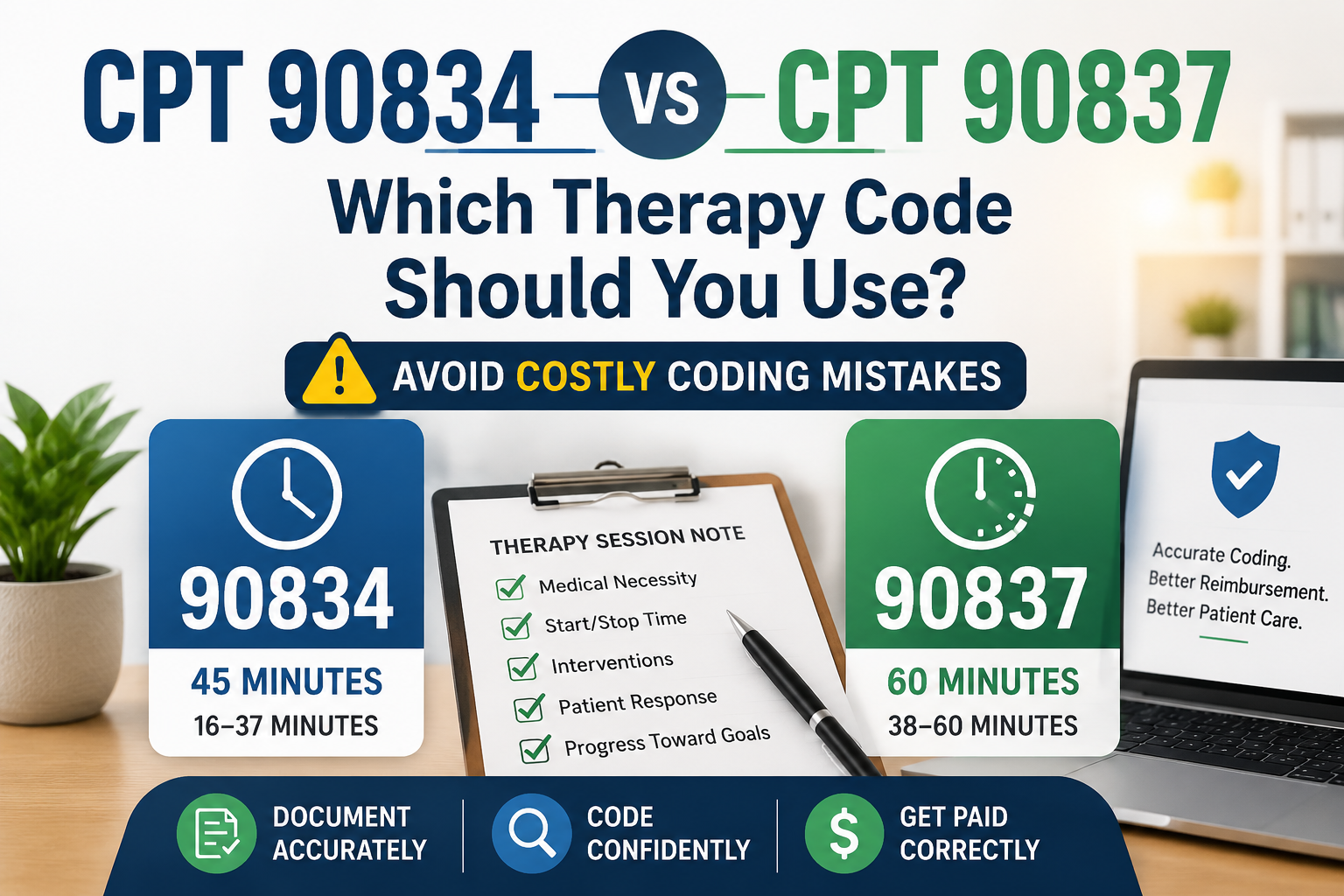
After the intake is complete, follow-up therapy usually moves to timed codes such as 90834 or 90837. Read our CPT 90834 vs. 90837 guide for a simple comparison.
Documentation Requirements for 90791 cpt code
Clear documentation is essential when billing the 90791 CPT code. The clinical note should show why the diagnostic evaluation was medically necessary and what the provider assessed.
Include:
- Chief complaint and current symptoms
- History of the present illness
- Psychiatric, medical, family, and social history
- Mental status examination
- Suicide, homicide, and self-care risk assessment
- Diagnosis or working diagnosis
- Treatment recommendations and care plan
The record should also include the patient’s details, date of service and the provider’s signature. Medicare expects the note to support a direct patient evaluation. This may be completed in person or through an approved telehealth encounter when Medicare and payer requirements are met.
Does 90791 Require Prior Authorization?
In many routine outpatient cases, the 90791 CPT code does not require prior authorization. However, the rule can change based on the patient’s insurance plan, provider network status and benefit type.
Some plans may require authorization for out-of-network care, Employee Assistance Program services, or specific behavioral health benefits. UnitedHealthcare, for example, publishes different authorization rules for certain plans and services.
Always verify eligibility and authorization requirements before the appointment. This simple step can prevent avoidable denials.
Need help checking payer-specific rules? Explore our Prior Authorization Services.
How Often Can 90791 Be Billed?
The 90791 CPT code is usually billed at the beginning of treatment when a full diagnostic evaluation is needed. It should not be billed routinely every few months without a clear clinical reason.
Medicare may allow another evaluation when there is:
- A long break in treatment
- A new episode of illness
- A psychiatric hospitalization or transition of care
- A major change in the patient’s mental status
- A need for a new diagnosis or treatment plan
The patient’s record must clearly explain why the repeat evaluation was medically necessary. Medicare frequency rules may also vary by regional contractor.
Medicaid and commercial insurance limits vary by plan. Always verify the payer’s policy before billing 90791 again.
CPT 90791 Reimbursement Rates
90791 cpt code reimbursement varies by payer, provider type, location and place of service. Medicare rates are updated regularly, while Medicaid and commercial insurance plans use their own fee schedules.
Payment may also differ based on the provider’s license and network contract. Psychiatrists and psychologists may receive a different rate than counselors, therapists, or clinical social workers.
Because there is no single payment amount for every claim, providers should review the latest payer contract or fee schedule before billing. Correct credentialing, eligibility verification and claim submission also help prevent underpayments and payment delays.
Telehealth Billing for CPT 90791
The 90791 CPT code can be billed for an approved live telehealth evaluation. Modifier 95 is commonly used for real-time audio and video visits. The GT modifier is only required in limited situations, such as certain Critical Access Hospital claims.
For Medicare professional claims, use POS 10 when the patient is at home and POS 02 when the patient is at another location. POS 11 represents an office visit and should only be used when the payer specifically requires it.
Audio-only rules vary. Medicare currently allows some behavioral health visits by audio-only when its conditions are met, but commercial and Medicaid plans may follow different rules.
Telehealth coverage and payment-parity laws also vary by state. Always verify the patient’s location, payer policy, required modifier and place of service before submitting the claim. If you want to learn more about telehealth billing, then explore our telehealth billing services.
Add-On Codes You Should Know
Some related codes may apply during mental health treatment, but they are not all add-ons to the 90791 CPT code.
90785 may be added to 90791 when communication difficulties make the evaluation more complex. The clinical note must explain why interactive complexity was present.
90833 and 90836 are psychotherapy add-on codes used with an eligible evaluation and management service. They should not be added to 90791.
90863 covers pharmacological management in limited situations, based on the provider’s qualifications, state law and payer rules. Medicare places additional restrictions on this code.
99050 and 99051 relate to services provided outside normal office hours. Coverage varies by payer, so verify payment rules before billing them.
Common Mistakes That Get 90791 Claims Denied
Claims for the 90791 CPT code are often denied because of simple billing or documentation errors.
Common mistakes include:
- Billing 90791 with psychotherapy or E/M services on the same date when the code combination is not allowed
- Failing to document a direct patient evaluation, including an approved telehealth visit
- Billing the code again without explaining the medical need for a new assessment
- Using the wrong diagnosis, modifier, place of service, or provider information
- Submitting an incomplete intake note
Always review the payer’s rules before filing the claim. Clear documentation and accurate coding can prevent delays, denials and payment loss.
Our Claim Submission Services help mental health practices submit cleaner claims and reduce avoidable billing errors.
Frequently Asked Questions
What is CPT code 90791, and when should it be used?
CPT code 90791 is used for a psychiatric diagnostic evaluation without medical services.
Use it for a new patient intake or when a medically necessary reassessment is required.
Does 90791 cpt code require a modifier?
A modifier is usually not needed for a standard in-person evaluation.
Telehealth claims may require modifier 95 or another payer-specific modifier.
What is the 90791 cpt code description and time?
The code describes a psychiatric diagnostic evaluation without medical services.
It is not a timed code, so there is no fixed minimum session length.
What does 90791 cpt code cover?
It covers a complete mental health assessment used to identify the patient’s condition.
The evaluation supports the diagnosis, medical necessity, and initial treatment plan.
What services are covered under CPT code 90791?
It may include the patient’s history, current symptoms, mental status exam, risk assessment, and diagnosis.
It also covers treatment recommendations and the initial plan of care.
Get 90791 Claims Right the First Time
Correct billing of the 90791 CPT code helps protect your practice from claim denials, payment delays, and compliance risks. Accurate coding and complete documentation also make it easier to receive the payment your practice has earned.
Our Claim Submission Services for Mental Health Providers can help you submit cleaner claims and avoid common billing mistakes.
Get Your Free Claims Review and find out where your billing process can improve.